Español
 日本語
日本語 Deutsch

Article Directory
You sit down at the start of a workday, and within a few hours the seat feels warm, your lower back starts to complain, and you find yourself fidgeting constantly to get comfortable. A full mesh office chair is built to address exactly those problems. It works by replacing foam and upholstery with a tensioned mesh surface that spreads your weight across a broad area, lets air move through continuously, and adapts its shape as you shift. The result is cooler, more even support that behaves differently from any foam-based chair.
That is the short answer. The longer answer involves the weave of the fabric, the tension it carries, and the frame engineered to hold everything in place. Here is how the system actually works.
What full mesh actually means
A full mesh chair uses mesh for both the backrest and the seat. Many chairs labeled as mesh chairs only have a mesh back, with the seat still made of foam. Those are hybrid designs. Full mesh is different: the seat panel is also a mesh surface stretched across a frame, with no foam or cushion underneath.
This distinction changes how the chair feels. With a foam seat, the foam compresses under your hips and eventually bottoms out, meaning the compressed pad becomes firm enough that you feel the hard frame beneath it. With a mesh seat, the panel stretches under load and distributes pressure over its entire surface. The first impression is firmer than foam, but the support is much more consistent.
The mesh itself is usually woven from nylon, polyester, or a blend with a controlled amount of stretch. The weave density and the tension applied during production determine the feel. A coarse, loosely woven mesh will sag quickly; a dense, evenly tensioned weave will hold its shape for years.
How the mesh suspension supports your weight
The mesh panel works as a tensioned membrane rather than a cushion. When you sit, your body weight pushes the panel downward, and the tension in the woven strands creates an opposing force. The deeper the panel sinks, the more strands are recruited to carry the load. That mechanism is fundamentally different from foam, which relies on compression in one localized area.
Pressure distribution and contact area
The membrane approach spreads pressure across the whole contact area. A foam cushion creates high-pressure zones at the ischial tuberosities, the two bones at the base of the pelvis. A mesh panel distributes that load from hip to knee across the seat and across the full width of the backrest. In practice, this means a full mesh chair often feels more comfortable after several hours than a foam chair, even if it feels firmer in the first minutes. It also avoids the hammock edge effect and the uneven ridges that foam develops as it wears.
Mesh tension and weave density
The quality of the chair depends on the quality of the tensioning. The strands must be tight enough to support you but elastic enough to conform to your body. Many better mesh chairs use a multi-zone weave: the lumbar area has a denser, firmer weave to support the lower spine, while the shoulder area uses a softer weave that moves with your arms and torso. The fabric also needs to recover its shape quickly after you shift. If it creeps, meaning it stays compressed after hours of loading, the chair will sag within a year.
The frame, the mechanism, and the base
The mesh panel is only as good as the structure holding it. The frame must stay rigid under load to maintain tension, and the base and mechanism underneath determine stability and durability.
The frame
Backrest frames are usually injection-molded nylon or aluminum alloy. Nylon is lighter but needs reinforcement at stress points; aluminum is more expensive but has a better strength-to-weight ratio. The seat frame carries most of the load and is the most reinforced part. When testing a chair, push down on the seat and lean back. You should not feel the frame flex or twist. A frame that flexes will eventually cause the mesh to lose tension and sag, no matter how good the fabric is.
Tilt and height mechanism
Below the seat, a gas lift controls height, and a tilt mechanism controls recline resistance. The tilt mechanism matters on a mesh chair because the mesh backrest moves with your spine instead of resisting it. It needs balanced resistance through the full recline range, plus adjustable tension so you can match the force to your body weight. A tilt lock is also useful if you prefer a fixed posture for part of the day. Some mechanisms offer synchronous tilt, where the backrest and seat move together to keep your torso and thighs at a stable angle. For a look at a full mesh model built around a mechanical tilt mechanism, the Y19 mechanical mesh chair shows the concept in practice.
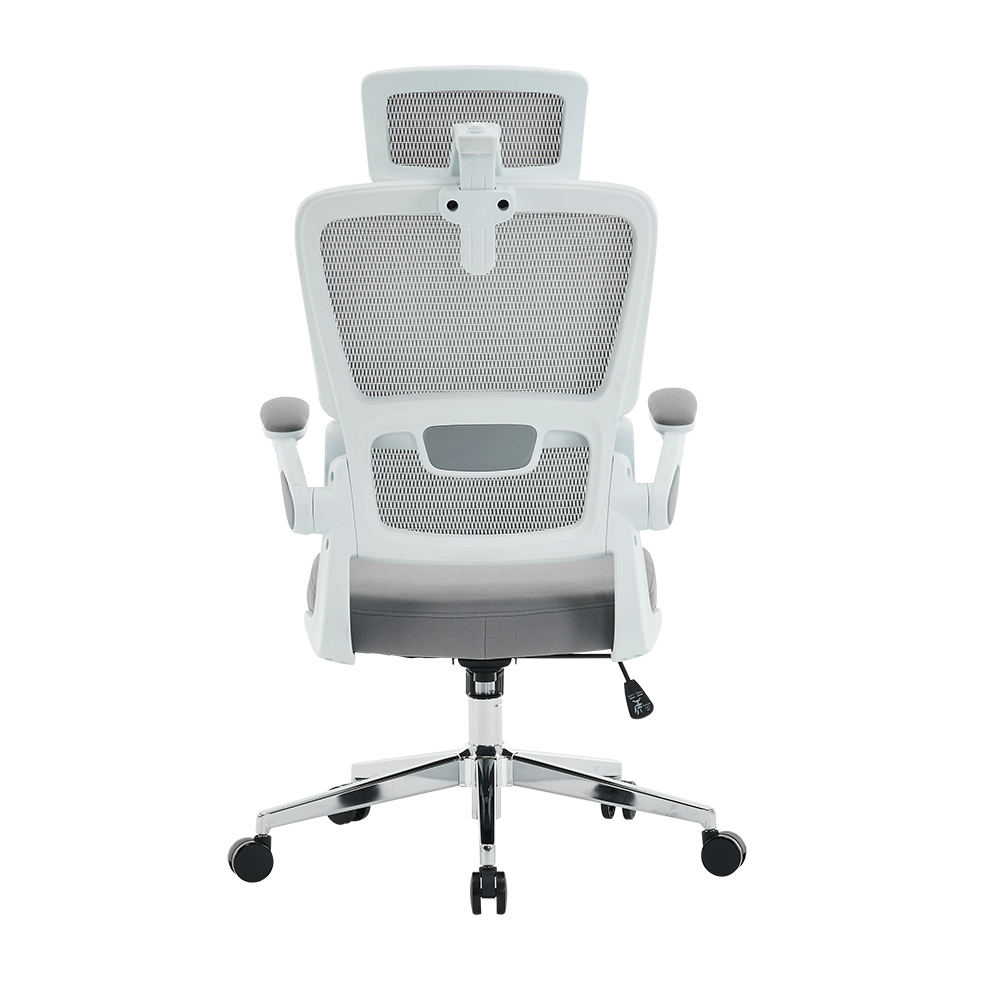 China Wholesale ODM/OEM 5115 Ergonomic chair Y19 mechanical mesh chair home offiAnji Kechen Furniture Co., Ltd. Is China Wholesale ODM/OEM 5115 Ergonomic chair Y19 mechanical mesh chair home office chair computer mesh...View Product →
Base and casters
The five-star base is the final load-bearing element. Nylon bases are heavier but often cheaper; aluminum bases are lighter and more corrosion-resistant. The casters should match your floor type: hard casters scratch hardwood, while soft casters drag on carpet. For a deeper look at how the base and caster design affects rolling stability and load transfer, our technical breakdown of mesh chair base and caster design covers the key factors.
Breathability and thermal comfort
The most obvious advantage of full mesh is airflow, and the mechanism is straightforward. The open weave leaves thousands of gaps between the strands. When you sit, body heat warms the thin layer of air between your skin and the chair. In a foam or leather chair, that warm air stays trapped, which is why you feel hot and sticky by mid-afternoon. In a mesh chair, the warm air exits through the gaps while cooler room air replaces it, creating a continuous micro-ventilation effect.
This is more than a comfort feature. Heat buildup under the thighs and lower back is a major trigger for restlessness and fatigue during long sitting sessions. If the temperature never stabilizes, you keep shifting and tensing muscles that should be at rest. A full mesh chair removes the heat trap where it matters most: the seat and the lower back.
The trade-off is that mesh airflow also works in cool environments. If you work in a cold office and tend to feel chilly, the constant airflow can feel drafty. That is one legitimate downside of full mesh. A chair like the durable breathable mesh chair made for long-time use shows how a carefully selected weave balances airflow and support.
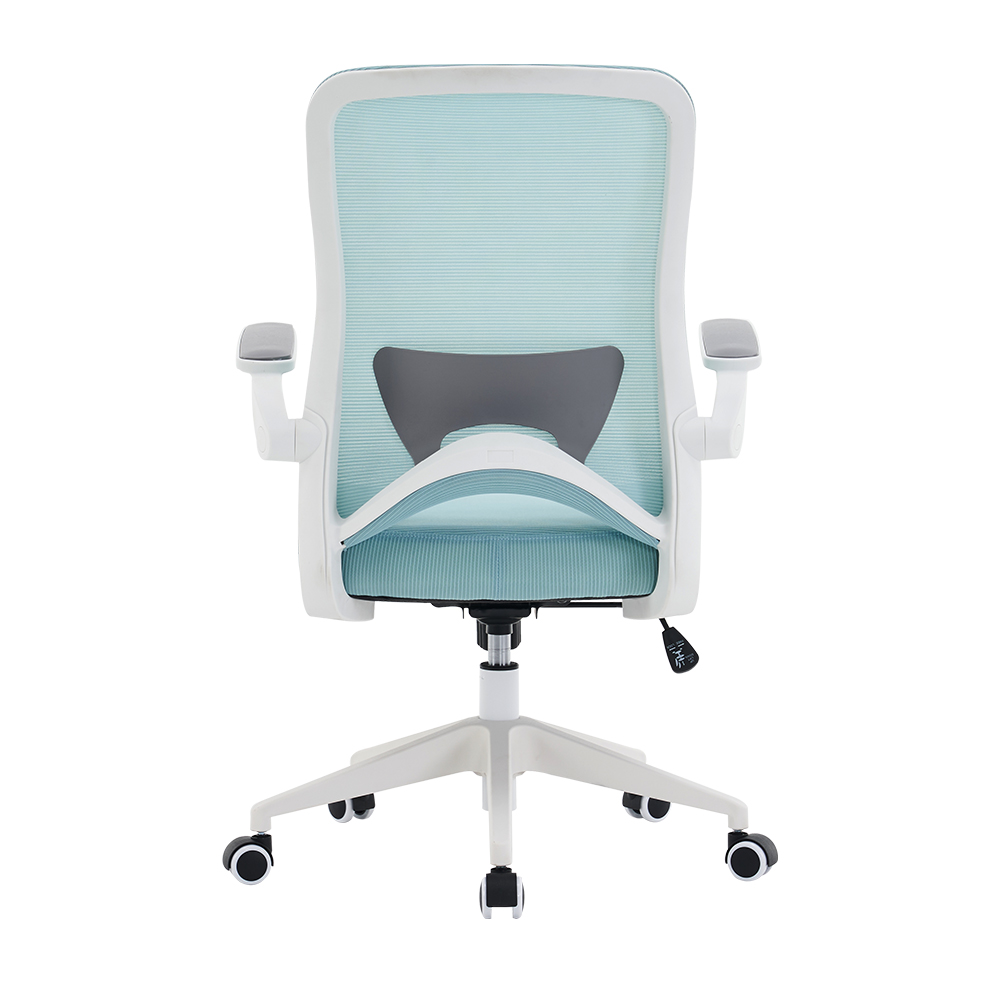 China Wholesale ODM/OEM 5123 Durable office chair comfortable breathable mesh chAnji Kechen Furniture Co., Ltd. Is China Wholesale ODM/OEM 5123 Durable office chair comfortable breathable mesh chair for long time use ...View Product →
Adjustability: making the system fit your body
A tensioned mesh panel adapts to your body shape, but it cannot replace basic adjustments. A full mesh chair still needs to be set to your proportions.
Seat height: with your feet flat on the floor and thighs roughly parallel to the ground, the seat should support your legs without pressing behind the knees. Because a mesh seat has no thick foam layer, the height setting is more sensitive. Setting it even a little too high makes the front edge of the mesh press into the backs of your thighs.
Tilt tension: the backrest should resist your lean with a steady force. If it flops back too easily or takes too much effort, adjust the tension knob until the resistance feels natural.
Lumbar support: the lumbar curve may be formed into the mesh panel itself, but an adjustable support is better for long hours. It needs to sit at the height of your natural lumbar curve, not higher or lower.
Armrests: fixed armrests are a red flag on any chair promoted for long work sessions. The ideal armrest adjusts in height at minimum; 2D and 3D designs add width and angle control so your shoulders can stay relaxed.
If you are comparing options and want to understand how seating preferences differ, our guide to choosing a mesh chair walks through the trade-offs in more detail.
What to check before you buy
A full mesh chair is an engineered product, so it pays to inspect more than the photos. Here is a practical checklist:
| Check | What to look for | Why it matters |
|---|---|---|
| Mesh weave | Dense, even weave with no loose strands | Determines pressure distribution and durability |
| Frame rigidity | Little flex when leaning back or shifting | Maintains mesh tension over time |
| Tilt mechanism | Adjustable tension, smooth motion, tilt lock | Controls recline feel and long-term reliability |
| Gas lift | Smooth height change, holds under load | Prevents sudden drops and stability problems |
| Casters | Matched to your floor type | Prevents damage and ensures smooth rolling |
| Lumbar support | Adjustable or well-positioned in the mesh | Protects the lower back during seated hours |
| Weight rating | Rated for your body weight | Prevents sagging, premature wear, and frame failure |
Red flags to avoid:
- Mesh that sags or shows a permanent stretch mark before you sit
- A seat frame that flexes when you lean sideways
- A tilt mechanism with no tension adjustment
- Fixed armrests on a chair described as ergonomic
- No clear weight rating
For a high-back option with a straightforward design, the high-back ergonomic mesh office chair is a solid starting point for comparison.
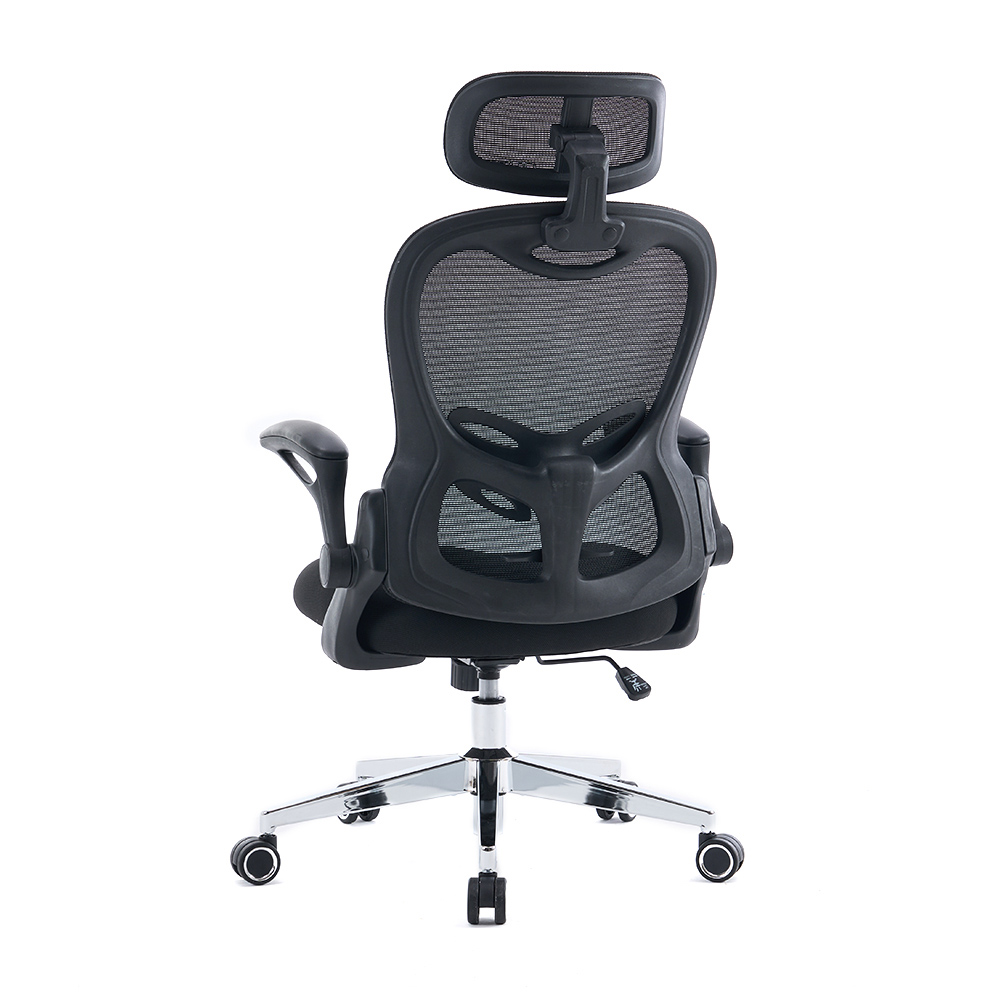 China Wholesale ODM/OEM 5140 Black/white ergonomic mesh office chair, high back Anji Kechen Furniture Co., Ltd. Is China Wholesale ODM/OEM 5140 Black/white ergonomic mesh office chair, high back computer chair Supplie...View Product →
If you want to understand the spinal benefits and limitations of this construction, we have covered mesh chair back support separately.
The bottom line
A full mesh office chair works because it replaces the compressible cushion with a tensioned membrane. The mesh spreads your weight over a larger contact area, removes the heat trap that foam creates, and returns to shape consistently as you move. Everything else, including the frame, the mechanism, and the base, exists to keep that membrane under the right tension for a long time.
When you buy, focus on weave quality, frame rigidity, and the tilt mechanism. Those components make the difference between a chair that works for years and one that sags after a few months. No chair removes the need to stand up and move during the day, but a well-designed full mesh chair makes the hours you do spend seated easier on your back and easier on your focus.